


Featured in Breads of Bombay
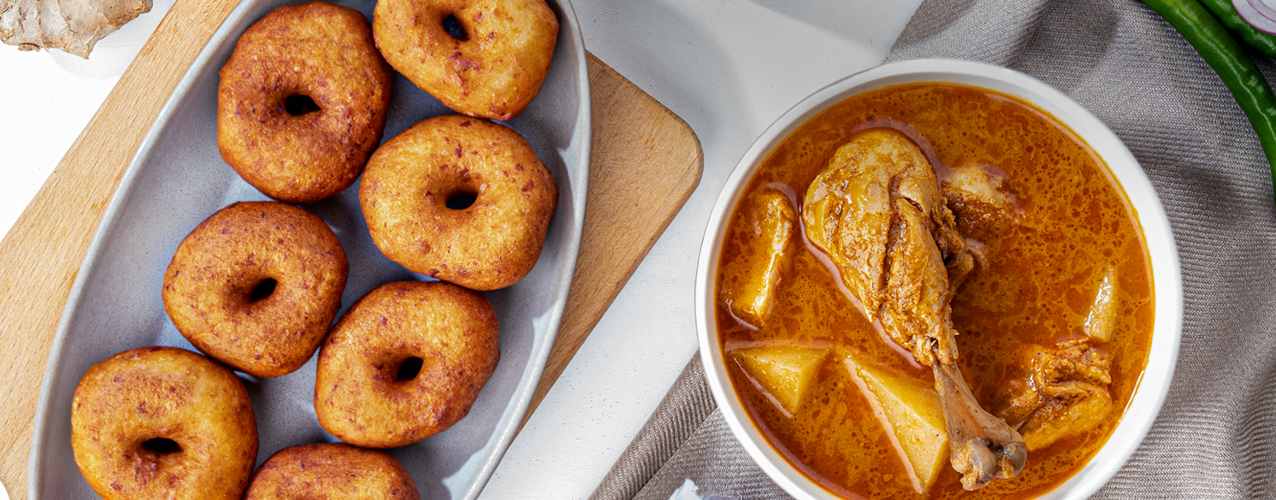
Bhokachi Wade & East Indian Chicken Curry
Golden, airy rings with a toddy-kissed tang


 Facebook
 X
X
 WhatsApp
 Email
Email
-
 Hob
Hob
Bhokachi Wades are golden, deep-fried breads born from the coastal kitchens of Bombay’s native Catholics. Made with a batter of urad dal and rice, the secret to their signature flavor lies in fermentation with toddy—palm sap that lends a subtle tang and airy texture. Once shaped and fried to perfection, these crisp-edged, fluffy-centered wades are best served hot with East Indian Chicken Khudi Curry. Traditionally prepared for weddings and feasts, they carry centuries of culinary adaptation and celebration in each bite, echoing a time when toddy was the soul of every festive kitchen.
Ingredients
For Khameeri Roti:
- 2 cups of whole wheat flour
- 1 tsp dry yeast
- 1 tsp sugar
- Salt as required
- 2 tsp butter
For Mutton Khichda:
- 3 finely sliced onions
- Broken wheat/khichda wheat
- 1 tsp oil
- ⅓ cup rice
- 1 cup dals (mix of urad dal, masoor dal, chana dal, toor dal, moong dal, green moong dal, chana)
- ½ kg mutton with bone
- 3 to 4 tsp coriander powder
- 2 tsp cumin powder
- 2 tsp garam masala
- 1 tsp turmeric
- 1 tsp red chilli powder
- Half a bunch coriander leaves
- 3 to 4 tsp ginger garlic & green chilli paste
- Tomato puree of 3 tomatoes
Method
For Bhokachi Wade:
- Soak urad dal overnight and coarsely grind into a paste.
- Combine all other ingredients in a bowl with some warm water.
- Let it ferment for about 3-4 hours at room temperature.
- Combine both the batters.
- Heat oil for deep frying.
- Take a small amount of dough on the palm of your hands with water.
- Form a ball then make a hole in the middle with your finger.
- Drop in hot oil and deep fry until golden brown.
- Remove the wades with a perforated spoon to remove excess oil.
- Each wade takes about 2 minutes to cook on each side.
- Serve immediately with Chicken Khudi Curry or East Indian style curry.
- For East Indian Chicken Curry:
- In a frying pan, dry roast the freshly grated coconut until lightly toasted. Remove from the pan and set aside.
- In the same pan, dry roast the onions, chilies, ginger, and garlic. Transfer to a food processor or blender and blend until smooth. Set aside.
- You can need 1/4 to 1/2 cup of water to help grind everything to a smooth paste.
- In a skillet over medium-high heat, stir-fry the chicken pieces in oil for two minutes until lightly browned on all sides.
- Add the ground masala paste and sauté for 2 minutes. Then add the bottle masala and saute for a minute more.
- If necessary add a few tbsp of water to prevent it from burning at the bottom.
- Add a cup of water and season with salt and pepper. Then, add the chopped potatoes – make sure the potatoes are immersed in the water.
- Cover and cook for 20 minutes until the chicken is cooked and the potatoes are tender.
- Finally, add the vinegar and cook for a minute more.
- Taste and adjust seasoning.
Find out more about the history and tradition of the dish
Dive into the rich stories, culture, and traditions behind India’s diverse regional cuisines.

Rate This Recipe



Similar Recipes
 11 mins
Chicken Chettinad

 16 mins
Chicken 65
 14 mins
Chicken Malai Tikka
 mins
mins
Khameeri Roti & Mutton Khichda
Product You May Like to Buy

Looks like you’re new here!
Let’s start by getting to know you better
Continue with this email or use a different one?